If you’re on the hunt for a modern flagship Mini-LED 4K TV that balances brightness, color, and high-end performance — and you want to avoid jumping straight to OLED — the TCL QM8K and Hisense U8QG represent two of the strongest options available. Both of these sets use quantum-dot enhanced Mini-LED technology to deliver vivid color, deep contrast, and extremely high peak brightness, while also offering next-generation gaming features and smart streaming platforms.
They’re part of a growing lineup of Mini-LED alternatives competing with premium OLED and QLED models (such as the popular Samsung QN90F). By offering near-OLED contrast with higher brightness and lower risk of burn-in, they give buyers a compelling middle ground. In this comparison, we break down how QM8K and U8QG differ — and which one may suit your living room or gaming setup best.
TCL QM8K — Short Review
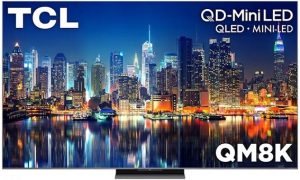
TCL QM8K
The TCL QM8K stands out for its combination of precise dimming control, strong contrast, ultra-bright HDR performance, and smooth motion. With a QD-Mini LED panel with claimed peak brightness of up to ~5000 nits depending on size and settings, it delivers bold highlights and deep blacks whether you’re watching films in a dark home theater or enjoying daytime sports in a bright living room.
It also excels in gaming with a native 144 Hz panel, VRR, and a special Game Accelerator 288 mode — allowing refresh rates up to 288 Hz at lower resolutions. Its low input lag makes it highly responsive for fast-paced gaming and next-gen consoles.
The QM8K also offers wide color reproduction, strong HDR format support including Dolby Vision, and impressive clarity across movies, streaming, and live broadcasts.
It runs on Google TV, ensuring a smooth smart-TV experience with a wide app selection and voice-assistant support. Connectivity is solid, and setup is straightforward for users who want premium performance without complexity.
Overall, the TCL QM8K delivers high-end Mini-LED performance, combining brightness, gaming power, and versatility into a TV that adapts well to every type of content.
| TCL QM8K Prices | |
| 98-Inch (98QM8K) | Check Today’s Price (Amazon.com)… |
| 85-Inch (85QM8K) | Check Today’s Price (Amazon.com)… |
| 75-Inch (75QM8K) | Check Today’s Price (Amazon.com)… |
| 65-Inch (65QM8K) | Check Today’s Price (Amazon.com)… |
Hisense U8QG — Short Review
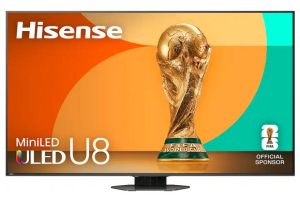
Hisense U8QG
The Hisense U8QG takes brightness and HDR punch even further, achieving claimed peak brightness of up to ~5000 nits depending on size and settings with its powerful Mini-LED backlight system. It uses thousands of local-dimming zones to maintain deep blacks and reduce blooming — making HDR movies, sports, and gaming visually striking and full of dimension.
Gamers will also love its support for 4K up to 165 Hz, making it one of the fastest 4K TVs available today. Combined with VRR and ALLM, motion remains crisp and fluid — a major advantage in action-heavy games and live sports.
It supports every major HDR format, including Dolby Vision and HDR10+, ensuring high-quality playback regardless of the streaming service or content type you choose.
Like the QM8K, it runs Google TV, giving you an intuitive and content-rich smart experience. Picture customization options are plentiful, and the TV easily adapts to various room lighting conditions.
All in all, the Hisense U8QG is a bright, versatile, and performance-driven Mini-LED TV that shines especially in environments where HDR impact and high refresh rates matter most.
| Hisense U8QG Prices | |
| 100-Inch (100U8QG) | Check Today’s Price (Amazon.com)… |
| 85-Inch (85U8QG) | Check Today’s Price (Amazon.com)… |
| 75-Inch (75U8QG) | Check Today’s Price (Amazon.com)… |
| 65-Inch (65U8QG) | Check Today’s Price (Amazon.com)… |
| 55-Inch (55U8QG) | Check Today’s Price (Amazon.com)… |
Specs & Key Feature Comparison Table
Here’s the key specifications comparison between TCL QM8K and Hisense U8QG.
| Feature | TCL QM8K | Hisense U8QG | |||||||||
| Display Technology | QD-Mini LED (QLED) | Mini-LED QLED (full-array local dimming) | |||||||||
| Screen Size Options | 65″, 75″, 85″, 98″ | 55″, 65″, 75″, 85″, 100″ | |||||||||
| Peak HDR Brightness | Up to ~5000 nits (claimed, varies by size) | Up to ~5000 nits (claimed, varies by size) | |||||||||
| HDR Support | Dolby Vision, HDR10+, HDR10, HLG | Dolby Vision, HDR10+, HDR10, HLG | |||||||||
| Refresh Rate / Gaming | 4K up to 144 Hz; 1080p/1440p up to 288 Hz; VRR; ALLM | 4K up to 165 Hz; 1080p up to 288 Hz; VRR; ALLM | |||||||||
| Smart TV Platform | Google TV / Android-based | Google TV / Android-based | |||||||||
| Audio / Built-in Sound | Bang & Olufsen-tuned speakers; Dolby Atmos & DTS Virtual:X | Built-in speakers; Dolby Atmos & DTS Virtual:X | |||||||||
| Price | Generally Higher | Generally Lower | |||||||||
|
|
TCL QM8K vs Hisense U8QG Comparison
Let’s compare TCL QM8K and Hisense U8QG in each aspect to decide which is the better choice for you.
Picture Quality
- TCL QM8K: Uses a QD-Mini LED panel (CrystGlow WHVA) with an advanced local-dimming system, delivering deep blacks and bright highlights. Its quantum-dot QLED layer helps produce wide color gamut and rich saturation, and the high native contrast helps maintain detail in dark scenes.
- Hisense U8QG: Also leverages Mini-LED backlight and QLED quantum-dot color to produce bright, vibrant colors and strong contrast. The set handles bright-room viewing well — highlights remain impactful, and contrast stays solid even in mixed lighting.
Winner: Draw — both deliver excellent picture quality, but QM8K offers slightly better black uniformity and dimming control, while U8QG leans toward a brighter, punchier image overall. Actual peak brightness and local dimming performance can vary slightly depending on screen size.
Motion and Gaming
- TCL QM8K: Supports a native 144 Hz refresh rate, and thanks to its “Game Accelerator 288” mode, can handle 1080p/1440p up to 288 Hz — offering smooth, low-lag gameplay. VRR and relevant gaming-friendly features are available for responsive console or PC gaming.
- Hisense U8QG: Steps up to 4K up to 165 Hz, plus supports 1080p up to 288 Hz, with VRR, multiple HDMI 2.1 ports, and USB-C alt-display input (on selected configurations) — a flexibility boon for PC gamers. Input lag is low, providing responsive performance, though some reviewers note pixel transition times are slightly slower than ideal, which might soften very fast motion.
Winner: Slightly to U8QG — the higher top refresh rate and broader connectivity give it a slight edge for hardcore gaming setups; but QM8K remains very strong, especially for console gaming.
HDR Support & Overall Performance
- TCL QM8K: Offers support for all major HDR formats — Dolby Vision, HDR10+, HDR10, HLG. The Mini-LED backlight plus quantum-dot panel helps bring HDR content to life with strong peak brightness and good tone mapping, enhancing both bright and dark details.
- Hisense U8QG: Matches with support for Dolby Vision, HDR10+, HDR10, HLG, and delivers vibrant, high-contrast HDR that shines especially in bright environments. HDR scenes and high-dynamic-range content tend to look punchy, colorful, and immersive.
Winner: Draw — both TVs offer comprehensive HDR support and handle HDR content strongly. Which performs “better” may depend on personal preference for contrast vs brightness.
Audio Quality
- TCL QM8K: Equipped with Bang & Olufsen–tuned speakers and support for Dolby Atmos (and often DTS Virtual:X), QM8K delivers balanced, clear, and relatively detailed sound straight out of the box. Its tuning tends to favor clarity and tonal balance — making dialogue, music, and cinematic content sound refined, without overly bloated bass or distortion typical of cheaper TVs. For viewers who value sound accuracy and neutrality, QM8K’s built-in audio is a strong point.
- Hisense U8QG: Features a built-in multi-driver speaker system with good wattage and “punchy” output, which tends to make its sound a bit more room-filling and impactful compared to many onboard TV speakers. That makes U8QG a compelling choice if you want louder, more immediate audio for movies, sports, or casual streaming — especially if you won’t be adding a separate soundbar or external speakers.
Winner: Depends on your priorities:
- For balanced, accurate, cinematic sound → TCL QM8K
- For louder, more punchy, room-filling sound out-of-the-box → Hisense U8QG
Price
- TCL QM8K: Available in 65″, 75″, 85″, and 98″, its pricing generally places it in the upper-mid to premium Mini-LED category. Pricing increases notably with larger screen sizes, so the 75″ and 85″ options can be significantly more expensive. It typically costs a bit more than similar-sized U8QG models, especially when stepping into the larger size classes.
- Hisense U8QG: Offered in 55″, 65″, 75″, 85″, and even 100″, it delivers high-performance Mini-LED value at a slightly more affordable price tier. Across most size options, U8QG tends to be priced lower than QM8K, making it a strong pick for buyers who want top-level brightness and gaming features without moving into a premium price bracket.
Winner: Hisense U8QG — better price-to-performance balance across most sizes, especially if budget is a key factor, although actual pricing still depends on retailer and ongoing promotions.
Which One Should You Choose?
If you want a well-balanced premium Mini-LED TV that performs brilliantly in almost any scenario — movies, sports, streaming, gaming — then the TCL QM8K is a fantastic choice. Its combination of strong contrast, smooth motion, and balanced sound quality makes it the more versatile everyday performer. Just keep in mind that larger sizes sit at a higher price tier, so you may be paying more for its do-everything strength.
| TCL QM8K Prices | |
| 98-Inch (98QM8K) | Check Today’s Price (Amazon.com)… |
| 85-Inch (85QM8K) | Check Today’s Price (Amazon.com)… |
| 75-Inch (75QM8K) | Check Today’s Price (Amazon.com)… |
| 65-Inch (65QM8K) | Check Today’s Price (Amazon.com)… |
However, if you prioritize maximum brightness, more aggressive HDR impact, and top-tier gaming performance — while also getting a better price-to-performance ratio — then the Hisense U8QG shines as the smarter buy. It delivers high-end Mini-LED performance at a more attractive cost, especially if you’re planning a big-screen setup or want one of the fastest gaming TVs available today.
| Hisense U8QG Prices | |
| 100-Inch (100U8QG) | Check Today’s Price (Amazon.com)… |
| 85-Inch (85U8QG) | Check Today’s Price (Amazon.com)… |
| 75-Inch (75U8QG) | Check Today’s Price (Amazon.com)… |
| 65-Inch (65U8QG) | Check Today’s Price (Amazon.com)… |
| 55-Inch (55U8QG) | Check Today’s Price (Amazon.com)… |