Choosing a mid-range Mini-LED TV in 2025 isn’t just about finding the brightest screen or the lowest price anymore. This category has become increasingly competitive, with brands now offering higher refresh rates, advanced local dimming, and modern gaming features that were once reserved for flagship models. Among the most talked-about options are the Sony BRAVIA 5 and TCL QM7K, two TVs that target buyers who want premium performance without stepping into OLED pricing.
Both models compete directly with other strong Mini-LED alternatives such as the Hisense U75QG, which focuses on aggressive brightness and value-driven performance. While Hisense often prioritizes raw specs and price, Sony and TCL take slightly different paths: Sony emphasizes processing quality and refined picture tuning, while TCL pushes higher refresh gaming and broader HDR format support. Understanding these differences is key to choosing the TV that best fits your viewing habits, room lighting, and gaming setup.
This comparison breaks down how the BRAVIA 5 and QM7K stack up across picture quality, HDR performance, motion handling, smart features, audio, and overall value — so you can decide which approach makes the most sense for your setup and budget.
Sony BRAVIA 5 — Short Review
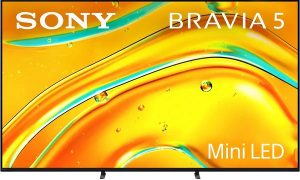
Sony BRAVIA 5
The Sony BRAVIA 5 delivers a refined 4K HDR experience rooted in Sony’s decades of display tuning and processing expertise. Its Mini-LED backlight with local dimming helps boost contrast and deliver deeper blacks compared with traditional LED TVs, while Sony’s processing aims for smoother gradients and natural colors — qualities that benefit movies and general TV viewing.
Sony includes Dolby Vision support for enhanced HDR playback, but it doesn’t support HDR10+. The set also comes with Google TV, giving access to a wide range of apps and a familiar smart interface, plus modern HDMI features like 4K @120Hz and VRR for gaming.
One advantage of the BRAVIA 5 is ATSC 3.0 (NEXTGEN TV) tuning for over-the-air broadcasts in supported regions (primarily the U.S.). However, its actual gaming performance — while solid with low input lag and VRR — isn’t as flexible as some rivals, and contrast performance can vary by size and settings.
Sony’s build quality and overall ownership experience tend to skew toward longevity and picture consistency, though that often comes at a higher price than similarly equipped alternatives.
| Sony BRAVIA 5 Prices | |
| 98-Inch (K-98XR50) | Check Today’s Price (Amazon.com)… |
| 85-Inch (K-85XR50) | Check Today’s Price (Amazon.com)… |
| 75-Inch (K-75XR50) | Check Today’s Price (Amazon.com)… |
| 65-Inch (K-65XR50) | Check Today’s Price (Amazon.com)… |
| 55-Inch (K-55XR50) | Check Today’s Price (Amazon.com)… |
TCL QM7K — Short Review
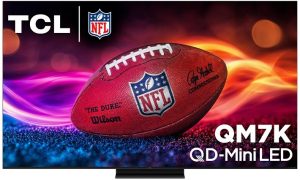
TCL QM7K
The TCL QM7K is TCL’s 2025 mid-range QD-Mini LED TV that emphasizes brightness, contrast, and gaming flexibility — all at a typically more aggressive price point than Sony’s BRAVIA 5. It features a 144Hz native refresh rate and support for high refresh 1080p @288Hz, delivering exceptionally smooth motion and responsiveness for games.
On the HDR front, the QM7K supports Dolby Vision, HDR10+, HDR10, and HLG — giving it broader format coverage than Sony’s set — and TCL’s local dimming system helps it push deep blacks and strong HDR highlights.
All models run Google TV as well, so you get the same smart platform ecosystem as Sony, but TCL typically clocks in with more HDMI bandwidth flexibility: two HDMI 2.1 ports (with VRR), plus eARC on a separate HDMI 2.0 port, so you don’t have to give up an HDMI 2.1 input for audio.
In everyday use, the QM7K often impresses with its bright picture and punchy contrast, making it a great all-around option for bright rooms and gaming sessions. It may not match Sony in refined color management or ease of calibration, but its feature list and performance often offer stronger bang for your buck.
| TCL QM7K Prices | |
| 115-Inch (115QM7K) | Check Today’s Price (Amazon.com)… |
| 98-Inch (98QM7K) | Check Today’s Price (Amazon.com)… |
| 85-Inch (85QM7K) | Check Today’s Price (Amazon.com)… |
| 75-Inch (75QM7K) | Check Today’s Price (Amazon.com)… |
| 65-Inch (65QM7K) | Check Today’s Price (Amazon.com)… |
| 55-Inch (55QM7K) | Check Today’s Price (Amazon.com)… |
Sony BRAVIA 5 vs TCL QM7K Specs & Key Features
Before diving into detailed comparisons, here’s a concise look at the core specs and features of Sony BRAVIA 5 and TCL QM7K.
| Feature / Spec | Sony BRAVIA 5 | TCL QM7K | |||||||||||
| Backlight | Mini-LED with local dimming | QD-Mini LED with local dimming | |||||||||||
| Panel Type | VA | VA | |||||||||||
| Resolution | 4K UHD (3840×2160) | 4K UHD (3840×2160) | |||||||||||
| Peak Brightness (HDR) | Strong but more modest relative to QM7K | Very high (TCL markets “HDR2600 Brightness”) | |||||||||||
| Local Dimming Zones | Moderate | More aggressive zone count | |||||||||||
| Native Refresh Rate | 120Hz | 144Hz | |||||||||||
| Max VRR | VRR up to 120Hz | VRR up to 144Hz (plus 1080p @ 288Hz) | |||||||||||
| Gaming Features | 4K@120Hz, VRR, ALLM | 4K@144Hz, VRR, 1080p@288Hz, ALLM | |||||||||||
| HDR Support | HDR10, HLG, Dolby Vision | HDR10, HDR10+, HLG, Dolby Vision | |||||||||||
| Smart Platform | Google TV | Google TV | |||||||||||
| HDMI Ports | 2× HDMI 2.1 (one is eARC), plus 2× HDMI 2.0 | 2× HDMI 2.1 + 2× HDMI 2.0 (one HDMI 2.0 is eARC) | |||||||||||
| ATSC Tuner | ATSC 3.0 | ATSC 1.0 only | |||||||||||
| Price | Higher | Lower | |||||||||||
|
|
Sony BRAVIA 5 vs TCL QM7K Comparison
Now let’s compare Sony BRAVIA 5 and TCL QM7K across the most important aspects to help you decide which one is the better fit.
Picture Quality
The TCL QM7K usually delivers a more immediately “wow” image because it pairs much stronger contrast with a higher zone count in testing (966 vs 384 on the tested units, depending on size). That helps it keep blacks deeper with bright highlights on screen, which is exactly where many mid-range Mini-LED TVs struggle.
The Sony BRAVIA 5, however, can still be the better pick if you prioritize a more natural, film-like presentation, plus Sony’s reputation for handling lower-quality content and upscaling gracefully. It’s the kind of TV that can look “right” even when the source isn’t perfect—especially for cable, YouTube, and mixed streaming.
Winner: TCL QM7K (stronger contrast and dimming impact overall).
HDR Formats
This one is straightforward: both support Dolby Vision, but only the TCL QM7K supports HDR10+. If you watch a lot of Prime Video HDR10+ titles (or just want maximum format coverage), TCL has the clear edge.
Sony sticks to the more typical Sony HDR stack: HDR10 + HLG + Dolby Vision, no HDR10+.
Winner: TCL QM7K
Motion & Gaming
For gaming, the TCL QM7K is the more flexible and future-friendly choice: it supports 4K@144Hz, has VRR, and even supports 1080p@288Hz for competitive setups. Motion clarity in fast games tends to look cleaner as well thanks to faster pixel transitions compared to the BRAVIA 5’s slower response in Game Mode.
The Sony BRAVIA 5 is still “modern” for console gaming with 4K@120Hz + VRR and low input lag, but it’s not the best match for people who are sensitive to motion blur in fast action. Also, it only has two HDMI 2.1 ports, and one doubles as eARC, so multi-device gamers need to plan their setup carefully.
Winner: TCL QM7K
Smart Platform
This is essentially a draw: both run Google TV (version 12 in testing), with the usual strengths—broad app support, solid voice features, and easy discovery.
Winner: Draw
Audio
Neither TV replaces a real soundbar, but Sony typically puts more emphasis on “sound matched to the screen,” and the BRAVIA 5 includes Sony’s positioning-focused approach (Acoustic Multi-Audio branding on Sony’s product materials). TCL’s QM7K highlights branded tuning (BANG & OLUFSEN on TCL’s spec sheet) and supports Dolby Atmos pass-through via eARC like Sony does.
In practice, treat this category as “choose a soundbar either way,” and base the decision more on picture + gaming priorities.
Winner: Draw (plan on external audio either way).
Price & Value
This is where the TCL QM7K usually pulls ahead: it’s positioned as a value-forward Mini-LED with higher refresh gaming, broader HDR format support, and typically more aggressive discounting—especially in larger sizes.
Sony often commands a premium for its processing, tuning, and ecosystem advantages (and it does include ATSC 3.0), but when you compare raw performance-per-dollar, TCL tends to win the value argument more often.
Winner: TCL QM7K
Conclusion: Sony BRAVIA 5 or TCL QM7K?
If you want the best overall performance per dollar, especially for bright-room punch and gaming, the TCL QM7K is the smarter buy for most people. You get 4K@144Hz, excellent contrast, broader HDR support (Dolby Vision + HDR10+), and a port layout that keeps your HDMI 2.1 ports available for gaming even if you use eARC for a soundbar/receiver — all of which makes it a very easy TV to live with in a modern setup.
| TCL QM7K Prices | |
| 115-Inch (115QM7K) | Check Today’s Price (Amazon.com)… |
| 98-Inch (98QM7K) | Check Today’s Price (Amazon.com)… |
| 85-Inch (85QM7K) | Check Today’s Price (Amazon.com)… |
| 75-Inch (75QM7K) | Check Today’s Price (Amazon.com)… |
| 65-Inch (65QM7K) | Check Today’s Price (Amazon.com)… |
| 55-Inch (55QM7K) | Check Today’s Price (Amazon.com)… |
Choose the Sony BRAVIA 5 if you care most about a more refined, “Sony-style” presentation, want ATSC 3.0 for over-the-air TV, and your gaming needs are mainly 4K@120Hz on one primary device (PS5 / Xbox / PC) rather than a full multi-device high-refresh setup. It’s a good TV—but compared head-to-head, TCL is simply more aggressive in the areas most buyers notice first.
| Sony BRAVIA 5 Prices | |
| 98-Inch (K-98XR50) | Check Today’s Price (Amazon.com)… |
| 85-Inch (K-85XR50) | Check Today’s Price (Amazon.com)… |
| 75-Inch (K-75XR50) | Check Today’s Price (Amazon.com)… |
| 65-Inch (K-65XR50) | Check Today’s Price (Amazon.com)… |
| 55-Inch (K-55XR50) | Check Today’s Price (Amazon.com)… |