Buying an entry-level 4K TV in 2024–2025 is tricky because a lot of models look “similar” on the spec sheet, but they’re built for very different priorities. The Samsung Q7F (2025) is Samsung’s mainstream entry QLED option in its 2025 lineup, positioned between the Q6F and Q8F. Meanwhile, the Sony BRAVIA 3 (2024) is Sony’s affordable step-in BRAVIA model, focusing more on processing and everyday streaming than high-end gaming features.
This comparison also matters because these two sit in a crowded budget market with strong alternatives like the TCL QM6K (often cheaper and sometimes offering better contrast thanks to local dimming on certain models) and step-up options like the Sony BRAVIA 5 if you want noticeably better overall picture performance.
So the real question isn’t “Which brand is better?”—it’s whether you want Samsung’s QLED color + Tizen ecosystem or Sony’s Dolby Vision + Google TV and picture processing in the same general price tier.
Samsung Q7F (2025) — Short Review
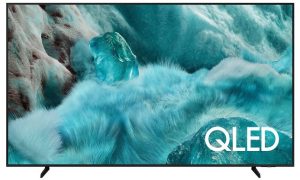
Samsung Q7F
The Samsung Q7F (2025) is a basic 4K LED QLED TV with a VA panel and a 60Hz native refresh rate. It’s designed more for casual viewing than premium home theater performance, and it’s important to set expectations: this model does not have local dimming, so black levels won’t look truly deep in a dark room.
For HDR, the Q7F supports HDR10, HDR10+, and HLG, but does not support Dolby Vision (typical for Samsung). That makes it a better match for HDR10/HDR10+ libraries, but it won’t take advantage of Dolby Vision mastering on Netflix/Disney+/Apple TV content.
For gaming, the Q7F is limited: it’s a 60Hz TV and doesn’t support HDMI 2.1, 4K/120, or VRR, so it’s not ideal if you’re buying specifically for PS5/Xbox Series performance features. It can still feel responsive at 60Hz for casual play, but it isn’t a “next-gen gaming TV.”
Smart features are handled by Tizen (2025 version, reduced features vs higher Samsung models), which is still easy to navigate and has broad app support. Audio is basic but fine for the price class: a built-in 20W 2.0-channel system, with limitations like no DTS support.
| Samsung Q7F Prices | |
| 98-Inch (QN98Q7FAAFXZA) | Check Today’s Price (Amazon.com)… |
| 85-Inch (QN85Q7FAAFXZA) | Check Today’s Price (Amazon.com)… |
| 75-Inch (QN75Q7FAAFXZA) | Check Today’s Price (Amazon.com)… |
| 65-Inch (QN65Q7FAAFXZA) | Check Today’s Price (Amazon.com)… |
| 55-Inch (QN55Q7FAAFXZA) | Check Today’s Price (Amazon.com)… |
| 50-Inch (QN50Q7FAAFXZA) | Check Today’s Price (Amazon.com)… |
| 43-Inch (QN43Q7FAAFXZA) | Check Today’s Price (Amazon.com)… |
Sony BRAVIA 3 (2024) — Short Review
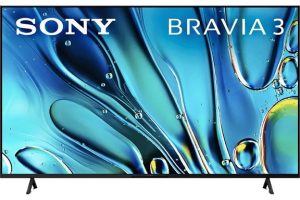
Sony Bravia 3
The Sony BRAVIA 3 is Sony’s entry-level 2024 4K TV. It uses an IPS panel (varied by size) with a 60Hz native refresh rate, which generally helps viewing angles compared to VA-type panels, but it still won’t deliver deep blacks—especially because it also does not include local dimming.
Where BRAVIA 3 stands out in this matchup is HDR ecosystem support. It supports HDR10 and HLG, and importantly Dolby Vision (but not HDR10+). If you watch a lot of Dolby Vision content, that alone can be a meaningful advantage over Samsung’s format strategy.
Gaming is also “basic but serviceable.” The BRAVIA 3 is limited to 4K at 60Hz and lacks HDMI 2.1 bandwidth and VRR, so it’s not a great choice for competitive or feature-driven console gaming. However, it does support ALLM and can still provide a responsive 60Hz experience for casual play.
Sony’s biggest everyday advantage is the smart platform and processing approach. The BRAVIA 3 runs Google TV (version 12), which tends to be excellent for app breadth, recommendations, and voice features. Sony also includes access to Sony Pictures Core, which is a nice bonus if you use Sony’s ecosystem. Audio is also straightforward: a built-in 20W 2.0-channel setup with support for formats like Dolby Atmos and DTS (useful if you pass audio to a soundbar/receiver via eARC).
| Sony BRAVIA 3 Prices | |
| 85-Inch (K-85S30) | Check Today’s Price (Amazon.com)… |
| 75-Inch (K-75S30) | Check Today’s Price (Amazon.com)… |
| 65-Inch (K-65S30) | Check Today’s Price (Amazon.com)… |
| 55-Inch (K-55S30) | Check Today’s Price (Amazon.com)… |
| 50-Inch (K-50S30) | Check Today’s Price (Amazon.com)… |
| 43-Inch (K-43S30) | Check Today’s Price (Amazon.com)… |
Samsung Q7F vs Sony BRAVIA 3 Specs & Key Features
Below is a side-by-side overview of the key specifications and features that define the Samsung Q7F and Sony BRAVIA 3:
| Spec / Feature | Samsung Q7F (2025) | Sony BRAVIA 3 (2024) | |||||||||||||
| Panel type | VA | IPS | |||||||||||||
| Available sizes | 43, 50, 55, 65, 75, 85, 98 | 43, 50, 55, 65, 75, 85 | |||||||||||||
| Native refresh rate | 60Hz | 60Hz | |||||||||||||
| Local dimming | No | No | |||||||||||||
| HDMI ports | 3× HDMI 2.0 | 4× HDMI 2.0 | |||||||||||||
| HDMI 2.1 / 4K120 | No | No | |||||||||||||
| VRR | No | No | |||||||||||||
| HDR formats | HDR10 / HDR10+ / HLG | HDR10 / Dolby Vision / HLG | |||||||||||||
| Smart TV platform | Tizen | Google TV | |||||||||||||
| Built-in speakers | 20W 2.0 | 20W 2.0 | |||||||||||||
| DTS support | No | Yes | |||||||||||||
| Price | Lower | Higher | |||||||||||||
|
|
Samsung Q7F and Sony BRAVIA 3 Comparison
Now that the key specs are covered, let’s see how the Samsung Q7F and Sony BRAVIA 3 stack up in real-world performance across the most important categories.
Picture Quality
The Samsung Q7F’s VA panel can be a plus if you mostly sit centered, but the TV’s lack of local dimming limits black depth and overall contrast performance. Sony’s BRAVIA 3 uses an IPS panel, which typically helps with wide seating, and Sony’s processing approach often benefits low-quality streaming cleanup, but it still suffers from weak contrast without local dimming.
Winner: Sony BRAVIA 3
HDR Formats
This is the clearest split. Samsung gives you HDR10+, but no Dolby Vision. Sony gives you Dolby Vision, but no HDR10+. Since Dolby Vision is widely used across major streaming platforms, it tends to be the more universally valuable format for many buyers.
Winner: Sony BRAVIA 3
Motion & Gaming
Both the Samsung Q7F and Sony BRAVIA 3 are limited to 4K at 60Hz and do not support HDMI 2.1 features such as 4K/120Hz or VRR, so neither is aimed at competitive or next-generation gaming. These TVs are clearly positioned for casual console and everyday gaming rather than high-performance setups.
That said, both models support ALLM (Auto Low Latency Mode), allowing them to automatically switch into Game Mode when a compatible console is detected. Input lag at 60Hz is low enough on both TVs for responsive casual gameplay, but the experience remains capped by the 60Hz panels and lack of advanced gaming features.
Winner: Draw
Smart Platform
Samsung’s Q7F uses Tizen (2025 version, reduced features compared to pricier Samsungs), which is still straightforward for most users. Sony’s BRAVIA 3 runs Google TV (v12), typically stronger for app ecosystem breadth and Google integration.
Winner: Sony BRAVIA 3
Audio Quality
Both sets use 20W 2.0-channel speakers, so neither is replacing a soundbar. However, the BRAVIA 3’s stronger support for common passthrough formats (including DTS) can be a practical edge if you connect external gear.
Winner: Sony BRAVIA 3
Price & Value
The Samsung Q7F typically has a clear advantage when it comes to pricing. In most regions, it’s regularly offered at a lower price than the Sony BRAVIA 3, especially during promotions, making it the more attractive option for buyers focused on value and screen size without moving into higher price tiers.
The Sony BRAVIA 3 usually costs more, with that premium tied to Dolby Vision support, Google TV, and Sony’s streaming-focused processing rather than hardware upgrades. While it can justify the extra cost for some users, it’s generally not the better value based on price alone.
Winner: Samsung Q7F
Which Is the Better Choice?
Choose the Samsung Q7F if you’re primarily focused on value and price-to-size ratio. In most markets, the Q7F is normally offered at a lower price than the Sony BRAVIA 3, especially during frequent Samsung promotions. This makes it appealing if you want a large-screen 4K TV for everyday viewing, cable TV, YouTube, and casual streaming without paying extra for premium processing or Dolby Vision. If budget is a key factor and you’re comfortable with HDR10+ instead of Dolby Vision, the Q7F delivers solid everyday performance for less money.
| Samsung Q7F Prices | |
| 98-Inch (QN98Q7FAAFXZA) | Check Today’s Price (Amazon.com)… |
| 85-Inch (QN85Q7FAAFXZA) | Check Today’s Price (Amazon.com)… |
| 75-Inch (QN75Q7FAAFXZA) | Check Today’s Price (Amazon.com)… |
| 65-Inch (QN65Q7FAAFXZA) | Check Today’s Price (Amazon.com)… |
| 55-Inch (QN55Q7FAAFXZA) | Check Today’s Price (Amazon.com)… |
| 50-Inch (QN50Q7FAAFXZA) | Check Today’s Price (Amazon.com)… |
| 43-Inch (QN43Q7FAAFXZA) | Check Today’s Price (Amazon.com)… |
Choose the Sony BRAVIA 3 if you prioritize a more refined streaming experience over upfront savings. While it typically costs more than the Samsung Q7F, the BRAVIA 3 justifies its higher price with Dolby Vision support, Google TV, and Sony’s stronger image processing for mixed-quality content. It’s the better option if you watch a lot of Netflix, Disney+, and Apple TV+ content, value Google ecosystem integration, or want a TV that feels more polished for long-term daily use—even if it means paying a bit more upfront.
| Sony BRAVIA 3 Prices | |
| 85-Inch (K-85S30) | Check Today’s Price (Amazon.com)… |
| 75-Inch (K-75S30) | Check Today’s Price (Amazon.com)… |
| 65-Inch (K-65S30) | Check Today’s Price (Amazon.com)… |
| 55-Inch (K-55S30) | Check Today’s Price (Amazon.com)… |
| 50-Inch (K-50S30) | Check Today’s Price (Amazon.com)… |
| 43-Inch (K-43S30) | Check Today’s Price (Amazon.com)… |