Mini-LED TVs have entered a new era, delivering brightness and contrast that rival OLED while avoiding its limitations. Among the standout contenders are the Hisense U8QG and Samsung QN90F, positioned to compete head-to-head with heavy hitters like the TCL QM8K. Though similar in ambition, their strengths differ enough that choosing the right one depends heavily on your room setup, viewing style, and gaming needs.
Even though the U8QG and QN90F compete in the same class, their priorities are slightly different. The Hisense U8QG bets big on maximum HDR brightness, Dolby Vision support, and powerful built-in audio, while the Samsung QN90F focuses on matte anti-glare performance, refined processing, and four HDMI 2.1 ports for flexible gaming setups. This comparison breaks down where each TV wins so you can decide which one better fits your room, viewing habits, and budget.
Hisense U8QG — Short Review
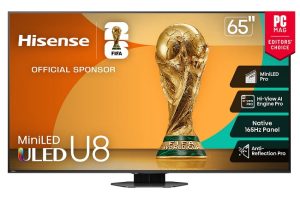
Hisense U8QG
The Hisense U8QG (2025) is the flagship 4K Mini-LED ULED from Hisense’s lineup. It’s available in 55″, 65″, 75″, 85″, and 100″ sizes. All sizes use a 4K Mini-LED Pro backlight with quantum-dot (QLED) color paired with an ADS Pro panel, which prioritizes wide viewing angles while still delivering strong contrast for a Mini-LED LCD.
Hisense advertises up to 5,000 nits of peak brightness, and real-world tests confirm extremely high HDR performance, with measured HDR peaks in the high-3,000-nit range on small highlights and even higher in brighter picture modes.
Combined with very high dimming-zone counts — up to 2,048 zones on 65″ and up to roughly 5,000 local dimming zones on the 100″ model — the U8QG delivers intense HDR highlights, excellent contrast, and impressive shadow detail.
HDR support is a major advantage: Dolby Vision IQ, HDR10+, HDR10, and HLG make it compatible with virtually every HDR format. Color vibrancy is strong thanks to quantum dots, and Mini-LED Pro dimming maintains accuracy even in challenging scenes.
Gaming performance is one of its biggest strengths. The U8QG supports native 165 Hz, 4K 165 Hz, 1080p 288 Hz, VRR (Game Mode Ultra 288), FreeSync Premium Pro, and ALLM. Input lag is very low, and the TV includes three HDMI 2.1 ports plus USB-C alt-display, making it flexible for PC, console, and laptop gaming.
The TV runs Google TV, offering broad app support, Chromecast built-in, personalized recommendations, and Google Assistant integration. Audio is stronger than typical TVs thanks to a 4.1.2-channel Dolby Atmos system, giving more immersion than most built-in TV speakers.
| Hisense U8QG Prices | |
| 100-Inch (100U8QG) | Check Today’s Price (Amazon.com)… |
| 85-Inch (85U8QG) | Check Today’s Price (Amazon.com)… |
| 75-Inch (75U8QG) | Check Today’s Price (Amazon.com)… |
| 65-Inch (65U8QG) | Check Today’s Price (Amazon.com)… |
| 55-Inch (55U8QG) | Check Today’s Price (Amazon.com)… |
Samsung QN90F — Short Review
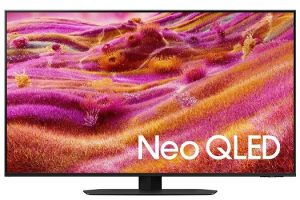
Samsung QN90F
The Samsung QN90F (2025) is Samsung’s flagship 4K Neo QLED Mini-LED TV and the direct successor to the QN90D. It’s available in 43″, 50″, 55″, 65″, 75″, 85″, and 98″, all using a Mini-LED backlight with quantum-dot color and Samsung’s NQ4 AI Gen3 processor.
One of its signature features is Samsung’s matte “Glare Free” screen, dramatically reducing reflections — one of the biggest advantages over Hisense and TCL models. HDR brightness is strong, reaching around 2,000 nits on a 10% HDR window in many independent measurements, and the TV maintains good accuracy thanks to Samsung’s processing. It uses fewer dimming zones than the U8QG but still provides excellent contrast.
HDR support includes HDR10, HDR10+, and HLG, though it does not support Dolby Vision.
Gamers get four HDMI 2.1 ports, 4K 120 Hz, 4K 144–165 Hz on PC, VRR, FreeSync Premium Pro, and low input lag. This makes the QN90F a top option for multi-device setups with multiple consoles and a gaming PC.
Samsung’s Tizen / Vision AI software adds features like Click to Search, Live Translate, and cloud gaming. Audio is a 4.2.2-channel 60 W system with Dolby Atmos and Object Tracking Sound, giving wider and more immersive sound than typical TV speakers.
| Samsung QN90F Prices | |
| 98-Inch (QN98QN90FAFXZA) | Check Today’s Price (Amazon.com)… |
| 85-Inch (QN85QN90FAFXZA) | Check Today’s Price (Amazon.com)… |
| 75-Inch (QN75QN90FAFXZA) | Check Today’s Price (Amazon.com)… |
| 65-Inch (QN65QN90FAFXZA) | Check Today’s Price (Amazon.com)… |
| 55-Inch (QN55QN90FAFXZA) | Check Today’s Price (Amazon.com)… |
| 50-Inch (QN50QN90FAFXZA) | Check Today’s Price (Amazon.com)… |
| 43-Inch (QN43QN90FAFXZA) | Check Today’s Price (Amazon.com)… |
Specs & Key Feature Comparison
Before diving into detailed comparisons, here’s a concise look at the core specs and features of Hisense U8QG and Samsung QN90F.
| Feature | Hisense U8QG | Samsung QN90F | ||||||||||||
| Display Technology | Mini-LED ULED (QLED) | Neo QLED Mini-LED | ||||||||||||
| Anti-Glare | Standard anti-reflection | Matte Glare-Free | ||||||||||||
| Screen Sizes | 55″, 65″, 75″, 85″, 100″ | 43″, 50″, 55″, 65″, 75″, 85″, 98″ | ||||||||||||
| Local Dimming Zones | Up to 5,000 zones (100″) | Up to ~900 zones | ||||||||||||
| HDR Formats | Dolby Vision IQ, HDR10+, HDR10, HLG | HDR10, HDR10+, HLG (no Dolby Vision) | ||||||||||||
| Peak Brightness | Up to 5,000 nits (measured ~3,900) | Around 2,000 nits | ||||||||||||
| Refresh Rate | Native 165 Hz | Native 165 Hz | ||||||||||||
| HDMI Ports | 3 × HDMI 2.1, 1 × HDMI 2.0, USB-C | 4 × HDMI 2.1 | ||||||||||||
| Gaming Features | VRR 288, FreeSync Premium Pro, ALLM | VRR, FreeSync Premium Pro, ALLM | ||||||||||||
| Smart Platform | Google TV | Tizen / Samsung Vision AI | ||||||||||||
| Audio | 4.1.2-ch ~72 W, Dolby Atmos | 4.2.2-ch 60 W, Dolby Atmos | ||||||||||||
| Price | Lower | Higher | ||||||||||||
|
|
Hisense U8QG vs Samsung QN90F Comparison
Now let’s compare Hisense U8QG and Samsung QN90F across the most important aspects to help you decide which one is the better fit.
Picture Quality
Both TVs use Mini-LED with quantum-dot color, so you’re getting very bright HDR, strong contrast, and wide color gamut either way. The U8QG pushes brightness further, with more dimming zones and higher measured peak nits, so HDR highlights (sparks, sun glints, explosions) look more intense and “premium” on this set. In darker viewing, its high zone count helps keep blooming around bright objects in check, especially at larger screen sizes where there are more dimming zones to work with.
The QN90F still gets very bright in HDR and delivers excellent contrast, but it’s generally a step behind the U8QG in raw highlight output. Where it fights back is with its matte anti-glare coating and consistently strong off-axis performance, which keeps the image looking clean across wider seating. For rooms with difficult lighting and side-seating, this can matter more than an extra few hundred nits on paper.
Winner: Hisense U8QG — for pure HDR punch and brightness; QN90F is better if your priority is glare handling and wide seating in a bright room.
HDR Format & Performance
The U8QG has a clear format advantage: it supports Dolby Vision IQ, HDR10+, HDR10, and HLG, so almost any HDR stream or disc is displayed with its intended dynamic metadata. Dolby Vision is still very common on major streaming platforms and UHD Blu-rays, and paired with the U8QG’s brightness, it creates a very impactful HDR experience.
The QN90F sticks to Samsung’s usual HDR10 / HDR10+ / HLG approach with no Dolby Vision support. Tone-mapping is good, and HDR10+ content can look fantastic, but if you watch a lot of Dolby Vision titles, those will fall back to HDR10 on the QN90F.
Winner: Hisense U8QG — broader HDR format support (including Dolby Vision IQ) plus higher peak brightness.
Motion & Gaming
For gaming, both are top-tier Mini-LED options:
- Hisense U8QG: Native 165 Hz panel with support for up to 4K 165 Hz and 1080p 288 Hz in Game Mode Ultra; FreeSync Premium Pro; ALLM; low input lag. Great if you want extremely high frame rates with a powerful PC and are okay with three HDMI 2.1 ports plus a USB-C display input.
- Samsung QN90F: Native 165 Hz refresh rate, full 4K 165 Hz over HDMI 2.1, VRR, FreeSync Premium Pro, ALLM, and very low latency (~9.5 ms), making it excellent for competitive gaming with multiple devices attached via its four HDMI 2.1 ports.
Both handle motion well for sports and fast action, and both offer strong game-mode picture quality.
Winner: Draw — U8QG wins on maximum refresh versatility and USB-C flexibility; QN90F wins on having four HDMI 2.1 ports and excellent bright-room gaming.
Smart TV Platform
The U8QG runs Google TV, which many people like for its content-first home screen, universal watchlists, Chromecast built-in, and simple integration with Google Assistant smart-home setups. App support is broad, and navigation is straightforward.
The QN90F uses the latest Tizen / Vision AI platform, which brings features like Click to Search, Live Translate, cloud gaming integrations, and Samsung TV Plus channels. It’s feature-rich and powerful, but some reviewers find the interface a bit busy compared with Google TV.
Both have all major streaming apps. Choosing between them is mostly about whether you prefer Google’s ecosystem or Samsung’s ecosystem.
Winner: Draw — Google TV is cleaner and more universal; Tizen / Vision AI offers deeper Samsung-specific features.
Audio Quality
The U8QG stands out with a 4.1.2-channel, ~72 W audio system with Dolby Atmos and IMAX Enhanced branding. It places drivers in a way that can create a more enveloping soundstage than many built-in TV systems, with decent dialogue clarity and some height-effect presence, though low-bass still isn’t at subwoofer levels.
The QN90F offers a 4.2.2-channel 60 W setup with Dolby Atmos and Object Tracking Sound. It also creates a nice sense of width and positional cues, but multiple reviews note that while it’s good, it still benefits from pairing with a dedicated soundbar for more impact.
On paper, Hisense provides a bit more power and a more aggressive audio configuration; in practice, both are above average, but neither fully replaces a good external system.
Winner: Hisense U8QG — slightly more powerful and immersive built-in audio, though both pair well with a soundbar.
Price & Value
Pricing moves with promotions, but trends are fairly consistent.
The Hisense U8QG is often highlighted as a “value-flagship”: its list price already undercuts some rivals, and it frequently drops under the four-figure mark at 65 inches during deals, while delivering higher brightness and better HDR format support.
The Samsung QN90F commands a price premium at similar sizes, largely due to brand positioning, anti-glare tech, and overall refinement. Reviews frequently praise its performance but also note that rivals like Hisense U8QG and TCL QM8K offer similar or better picture quality for less money.
If you are purely chasing performance for the price, the U8QG tends to come out ahead. If you’re willing to pay more for Samsung’s design, matte screen, and ecosystem, QN90F still delivers a very strong experience.
Winner: Hisense U8QG — typically offers more brightness, more HDR compatibility, and strong gaming features at a lower or similar price.
Which is Better?
If you want the most impactful HDR and overall performance for the money, the Hisense U8QG is very hard to beat. It delivers extreme brightness, dense Mini-LED dimming, full HDR format support (including Dolby Vision IQ), powerful sound, and 165 Hz gaming. For movie watching, streaming, or high-refresh gaming in bright or dark rooms, it’s a “do-everything” Mini-LED that feels like a flagship without the flagship price tag.
| Hisense U8QG Prices | |
| 100-Inch (100U8QG) | Check Today’s Price (Amazon.com)… |
| 85-Inch (85U8QG) | Check Today’s Price (Amazon.com)… |
| 75-Inch (75U8QG) | Check Today’s Price (Amazon.com)… |
| 65-Inch (65U8QG) | Check Today’s Price (Amazon.com)… |
| 55-Inch (55U8QG) | Check Today’s Price (Amazon.com)… |
On the other hand, if your space is very bright, you have windows or lights facing the screen, and you value glare-free viewing, multiple HDMI 2.1 ports, and Samsung’s polished Tizen ecosystem, the Samsung QN90F is a compelling choice. Its matte anti-glare screen, strong Mini-LED brightness, and complete connectivity make it especially appealing for sports, daytime TV, or multi-device gaming rigs where reflection control and versatility matter as much as peak nits.
| Samsung QN90F Prices | |
| 98-Inch (QN98QN90FAFXZA) | Check Today’s Price (Amazon.com)… |
| 85-Inch (QN85QN90FAFXZA) | Check Today’s Price (Amazon.com)… |
| 75-Inch (QN75QN90FAFXZA) | Check Today’s Price (Amazon.com)… |
| 65-Inch (QN65QN90FAFXZA) | Check Today’s Price (Amazon.com)… |
| 55-Inch (QN55QN90FAFXZA) | Check Today’s Price (Amazon.com)… |
| 50-Inch (QN50QN90FAFXZA) | Check Today’s Price (Amazon.com)… |
| 43-Inch (QN43QN90FAFXZA) | Check Today’s Price (Amazon.com)… |