The budget Mini-LED TV category in 2025 has become far more competitive than ever, with features like high refresh rates, HDMI 2.1 gaming support, and advanced HDR now common at affordable price points. Sets in this price tier now include features that were once reserved for mid-range models, narrowing the gap between budget and premium TVs. Two of the most popular “value Mini-LED” picks are the Hisense U65QF (U6 Series Fire TV) and the TCL QM6K (QM6 Series Google TV), and they’re closer than you’d expect.
They also sit in a crowded field with models like the TCL QM7K (a step up in TCL’s lineup) and Hisense’s own U75QG / U8QG (brighter, more premium). If you’re trying to stay under “mid-range” pricing, the U65QF and QM6K are usually the two that make the most sense to compare first.
In this comparison, we’ll keep it practical: picture performance, HDR support, gaming, smart platforms, audio, and overall value—then give clear recommendations for each type of buyer.
Hisense U65QF — Short Review
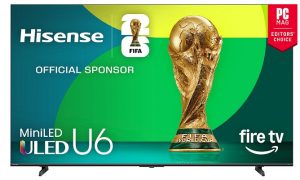
Hisense U65QF
The Hisense U65QF is designed to deliver that “wow, this is budget?” effect: it’s a Mini-LED TV with local dimming that aims for high brightness and strong HDR pop, which is exactly what most people want from an affordable living-room TV. It’s positioned below the U75QG and U8QG, but it still comes loaded with modern features for the money.
For gaming, it’s legitimately competitive: it has two HDMI 2.1 ports with up to 4K @ 144Hz and VRR, which covers the key next-gen console and PC needs (especially if you only require one 2.1 input for a PS5 / Xbox Series X).
One of the biggest differentiators is the platform and “future-proof” extras. The U65QF runs Fire TV, and includes ATSC 3.0 (NextGen TV) support and Wi-Fi 6, which are both meaningful upgrades at this price.
In real-world performance testing, the U65QF measures as much brighter in SDR and brighter in HDR than the QM6K—exactly the kind of difference you notice in daylight viewing and punchy HDR highlights.
The trade-offs are typical for budget Mini-LED: limited viewing angles and the potential for some blooming in challenging scenes. But if you’re buying a brighter, punchier TV for mixed content (sports, YouTube, streaming, casual gaming), the U65QF tends to feel like the “easy pick.”
| Hisense U65QF Prices | |
| 100-Inch (100U65QF) | Check Today’s Price (Amazon.com)… |
| 85-Inch (85U65QF) | Check Today’s Price (Amazon.com)… |
| 75-Inch (75U65QF) | Check Today’s Price (Amazon.com)… |
| 65-Inch (65U65QF) | Check Today’s Price (Amazon.com)… |
| 55-Inch (55U65QF) | Check Today’s Price (Amazon.com)… |
TCL QM6K — Short Review
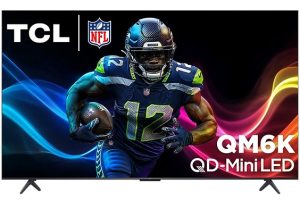
TCL QM6K
The TCL QM6K is TCL’s entry-level 2025 Mini-LED step-up that replaces the older Q6/Q651G class with Mini-LED backlighting and significantly better gaming support than TCL’s previous budget QLED tier.
On paper, it’s a spec-forward TV: It has 4K @ 144Hz support plus an extra trick—1080p @ 288Hz—along with VRR, delivered through two HDMI 2.1 ports (with the other HDMI ports being 2.0, including an eARC port).
TCL also leans hard into motion/gaming presentation. On the official product page, TCL highlights 144Hz native refresh rate, Game Accelerator 288, and FreeSync Premium Pro, which reinforces that this TV is trying to be the “budget gamer” choice.
For smart TV usability, the QM6K uses Google TV, which many buyers prefer for recommendations, voice search, and overall app ecosystem. The TCL QM6K is also slightly thinner in design (though design isn’t usually the deciding factor in this class).
Where it tends to fall behind is pure brightness and a couple of “nice to have” features: Independent lab testing shows lower SDR and HDR brightness than the Hisense, and it also notes the QM6K lacks ATSC 3.0 and uses Wi-Fi 5 (TCL’s own specs list Wi-Fi 5).
Bottom line: the QM6K is a strong value Mini-LED if your priority is fast gaming + Google TV, but for bright-room punch and extra features, it usually plays second to the Hisense.
| TCL QM6K Prices | |
| 98-Inch (98QM6K) | Check Today’s Price (Amazon.com)… |
| 85-Inch (85QM6K) | Check Today’s Price (Amazon.com)… |
| 75-Inch (75QM6K) | Check Today’s Price (Amazon.com)… |
| 65-Inch (65QM6K) | Check Today’s Price (Amazon.com)… |
| 55-Inch (55QM6K) | Check Today’s Price (Amazon.com)… |
Hisense U65QF vs TCL QM6K Specs & Key Features
Below is a side-by-side overview of the key specifications and features that define the Hisense U65QF and TCL QM6K.
| Spec / Feature | Hisense U65QF | TCL QM6K | ||||||||||
| Backlight / Tier | Mini-LED (budget ULED tier) | QD-Mini LED (QM6 series) | ||||||||||
| Screen Size Options | 55″, 65″, 75″, 85″, 100″ | 55″, 65″, 75″, 85″, 98″ | ||||||||||
| Native Refresh Rate | 144Hz | 144Hz | ||||||||||
| HDMI Ports | 2× HDMI 2.1 + 2× HDMI 2.0 | 2× HDMI 2.1 + 2× HDMI 2.0 (eARC on one 2.0) | ||||||||||
| Gaming Support | Up to 4K @ 144Hz + VRR | 4K @ 144Hz + 1080p @ 288Hz + VRR | ||||||||||
| HDR Formats | Dolby Vision, HDR10+, HDR10, HLG | Dolby Vision, HDR10+, HDR10, HLG | ||||||||||
| Smart Platform | Fire TV | Google TV | ||||||||||
| ATSC 3.0 (NextGen TV) | Yes | No | ||||||||||
| Wi-Fi | Wi-Fi 6 | Wi-Fi 5 (802.11ac) | ||||||||||
| Price | Typically Lower | Typically Higher | ||||||||||
|
|
Hisense U65QF and TCL QM6K Comparison
With the specs out of the way, let’s break down how the Hisense U65QF and TCL QM6K compare in real-world performance across the most important categories.
Picture Quality
If you watch in a bright room—or you simply like punchy HDR—the Hisense U65QF has the clearer advantage. Independent testing shows the U65QF delivering significantly higher SDR brightness and higher HDR brightness than the QM6K, which translates into a more vibrant image in daylight and stronger highlight impact in HDR movies.
Winner: Hisense U65QF
HDR Formats
This is basically a tie: both sets support the major HDR formats people care about, including Dolby Vision and HDR10+, plus HDR10 and HLG.
Winner: Draw
Motion & Gaming
Both TVs are excellent for the price with two HDMI 2.1 ports, VRR, and 4K @ 144Hz capability.
But the TCL QM6K has a real gaming-specific edge: It can also do 1080p @ 288Hz, which is especially attractive for PC gamers chasing ultra-high frame rates.
Winner: TCL QM6K
Smart Platform & Features
If you prefer a cleaner, more universal smart TV experience, Google TV on the TCL is often the safer bet.
However, the Hisense Fire TV model stands out for its extra “features stack,” including ATSC 3.0 and Wi-Fi 6. For most buyers, those extras matter more than platform preference.
Winner: Hisense U65QF
Audio Quality
Both are “fine” for everyday viewing, but neither is a replacement for a soundbar in a movie-focused setup. TCL’s own specs list 40W total audio power on the QM6K (2.1 channel configuration).
Given how close this class tends to be—and since your best upgrade is external audio anyway—this category is effectively even.
Winner: Draw
Price & Value
Hisense U65QF came in at a lower price at the time of writing and also scored higher overall due to performance and features. If pricing stays close, the Hisense usually offers the stronger “value per dollar.”
Winner: Hisense U65QF
Which Is Better?
When you look at the full picture, the Hisense U65QF emerges as the better overall TV for most buyers. Its noticeably higher SDR and HDR brightness, combined with useful extras like ATSC 3.0 (NextGen TV) and Wi-Fi 6, make it more versatile for everyday viewing in bright rooms. Add solid Mini-LED contrast and modern HDMI 2.1 gaming support, and the U65QF delivers a stronger all-around value package.
| Hisense U65QF Prices | |
| 100-Inch (100U65QF) | Check Today’s Price (Amazon.com)… |
| 85-Inch (85U65QF) | Check Today’s Price (Amazon.com)… |
| 75-Inch (75U65QF) | Check Today’s Price (Amazon.com)… |
| 65-Inch (65U65QF) | Check Today’s Price (Amazon.com)… |
| 55-Inch (55U65QF) | Check Today’s Price (Amazon.com)… |
That said, the TCL QM6K still makes a compelling case for a specific audience. If your priority leans heavily toward gaming performance, especially PC gaming, its ability to run 1080p at 288Hz, along with 4K at 144Hz, gives it an edge in responsiveness. Pair that with the familiar Google TV platform, and the QM6K becomes the better choice for gamers who value ultra-high frame rates and Google’s ecosystem over maximum brightness.
| TCL QM6K Prices | |
| 98-Inch (98QM6K) | Check Today’s Price (Amazon.com)… |
| 85-Inch (85QM6K) | Check Today’s Price (Amazon.com)… |
| 75-Inch (75QM6K) | Check Today’s Price (Amazon.com)… |
| 65-Inch (65QM6K) | Check Today’s Price (Amazon.com)… |
| 55-Inch (55QM6K) | Check Today’s Price (Amazon.com)… |